
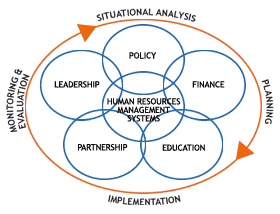
HR Management Systems
Areas of Intervention
- Personnel systems: workforce planning (including staffing norms), recruitment, hiring and deployment
- Work environment and conditions: employee relations, workplace safety, gender equity, job satisfaction and career development
- HR information system integration of data sources to ensure timely availability of accurate data required for planning, training, appraising and supporting the workforce
- Performance management: performance appraisal, supervision and productivity.
Indicators
- HRM units in place and strategically located at national and local levels
- HR information system in place and used for HRH planning at all levels
- Performance management system in place.
Tools and Guidelines
Analysis of Labour Turnover Tool.
Ensuring a Positive Practice Environment: Occupational Safety and Health for Health Worker Productivity. CapacityPlus, 2012
Everybody’s Business: Strengthening Health Systems to Improve Health Outcomes: WHO’s Framework for Action. World Health Organization, 2007.
Exploring Contraceptive Use Differentials in Sub-Saharan Africa through a Health Workforce Lens. CapacityPlus, 2013
Foundations of Gender Equality in the Health Workforce. CapacityPlus, 2012
Governance Approaches to Reducing Absenteeism. CapacityPlus, 2012
Handbook for Measurement and Monitoring: Indicators of the Regional Goals for Human Resources for Health Pan American Health Organization / World Health Organization, 2010
HRH Global Resource Center eLearning Platform. CapacityPlus, 2011
HRH Global Resource Center. The Capacity Project/CapacityPlus, 2008
HRIS Strengthening Implementation Toolkit. CapacityPlus, 2011
Human Resource Management (HRM) Assessment Instrument for NGOs and Public Sector Health Organizations. Management Sciences for Health, 2006.
Human Resource Management (HRM) Assessment Tool for HIV/AIDS Environments. Management Sciences for Health (MSH), 2006.
Human Resources for Health: A Gender Analysis. Asha George, 2007.
Human Resources Management Assessment Approach. CapacityPlus, 2013
iHRIS Suite. Capacity/CapacityPlus, 2008
Integrating Family Planning and HIV/AIDS Services: Health Workforce Considerations. CapacityPlus, 2012
Management and Organizational Sustainability Tool (MOST). MSH, 2010
Monitoring the Building Blocks of Health Systems: A Handbook of Indicators and Their Measurement Strategies. World Health Organization, 2010.
Monitoring the Health Workforce: Measurement Issues and Tools. World Health Organization, 2008.
Population Growth and the Global Health Workforce Crisis. CapacityPlus, 2011
Rapid Retention Survey Toolkit: Designing Evidence-Based Incentives for Health Workers. CapacityPlus, 2012
Recruitment and Hiring. Management Sciences for Health (MSH), n.d.
Service Targets Staff Projection Tool: User Guide. 2011
Strengthening the Health Worker Pipeline through Gender-Transformative Strategies. CapacityPlus, 2012
Task Shifting: Rational Redistribution of Tasks Among Health Workforce Teams, Global Recommendations and Guidelines. World Health Organization, 2008.
West Africa’s Regional Approach to Strengthening Health Workforce Information. CapacityPlus, 2012
Workload Indicators of Staffing Need (WISN). WHO, 2010
Resources
A Model Linking Clinical Workforce Skill Mix Planning to Health and Health Care Dynamics. April 2010
An Overview of Human Resources for Health (HRH) Projection Models. The Capacity Project, 2008.
Attracting and Retaining Nurse Tutors in Malawi. The Capacity Project, 2006
Building the Bridge from Human Resources Data to Effective Decisions: Ten Pillars of Successful Data-Driven Decision-Making. The Capacity Project, 2008.
Data Quality Considerations in Human Resources Information Systems (HRIS) Strengthening. The Capacity Project, 2008.
Governance and Human Resources for Health. 2011
Health Workforce Skill Mix and Task Shifting in Low Income Countries: A Review of Recent Evidence. January 2011
Human Resources Management (HRM) in the Health Sector. The Capacity Project, 2006.
Incorporating Lay Human Resources to Increase Accessibility to Antiretroviral Therapy: A Home-Based Approach in Uganda. The Capacity Project, 2006.
Increasing Access to Health Workers in Remote and Rural Areas through Improved Retention. 2010
Information Systems on Human Resources for Health: A Global Review. 2012
Reducing Geographical Imbalances of Health Workers in Sub-Saharan Africa, World Bank. 2011
Strategy for the Rapid Start-up of the HIV/AIDS Program in Namibia: Outsourcing the Recruitment and Management of Human Resources for Health. The Capacity Project, 2006.
Using Staffing Ratios for Workforce Planning: Evidence on Nine Allied Health Professions. 2012
Validating a Work Group Climate Assessment Tool for Improving the Performance of Public Health Organizations. Human Resources for Health, 2005.
Workforce Planning for the Health Sector. The Capacity Project, 2006.